What Biodiesel Chemicals
are Used when Titrating?
Search this site!
A list of biodiesel chemicals used in titration can be found below.
The purpose of performing a biodiesel titration is to determine the acidity of the oil so it can be neutralized with a base. This is found by using a pH indicator and adding known amounts of the base solution until the pH indicator indicates it has been neutralized.
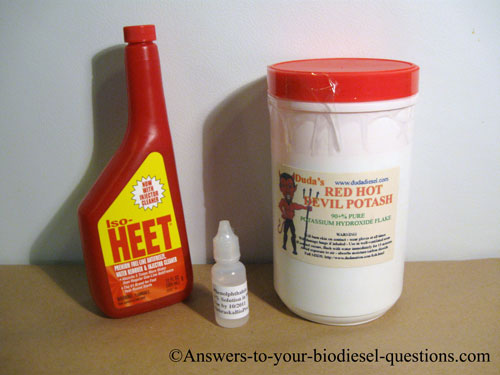
Catalysts Used by Home-brewers to Make a Titration Solution:
The catalyst you use to make your titration solution needs to be the same catalyst you will be using when making your batch. It also needs to be of the same purity. These catalysts are bases which will neutralize the acid in the oil.
* Potassium Hydroxide (also known as KOH and Potash) - Do not use anything less than 85% purity. Be sure to use the same purity of KOH for the titration and reaction. It is more popular than lye because it takes MUCH less time to dissolve in methanol.
Or...
* Sodium Hydroxide (also known as NaOH and Lye) - It is cheaper than Potash, and is easier to find. It should be at least 96% pure. Lye can be obtained from soap making supply stores. One thing to note - a dangerous hydrogen gas can form when lye comes in contact with aluminum, tin, brass, bronze, chromium and zinc. Many home brewers store lye in heavy plastic bags.
Chemicals Used in Titration:
* Isopropyl alcohol (isopropanol or rubbing alcohol) - Alcohol does not have a pH value, so it is used as a solvent in biodiesel titration.
* Phenolphthalein - This is a pH indicator. It is very accurate when used for oils low in free fatty acids. At a pH of 8.3 it begins to change to pink, at 10.5 it is red. When it just starts to turn pink and stays that way for 30 seconds, it is at a pH of 8.5. A solution of 1% Phenolphalein, with 95% ethanol should be used.
Where to Purchase?
You can find all the Titration Supplies you need at Duda's. Btw, the cost to ship a chemical can be double the cost of the chemical itself! I think the extra cost to ship them is worth not having to go track them all down locally.
Summary:
When your biodiesel titration is complete you will be able to calculate the amount of catalyst that is needed to create your batch of biofuel.
ON TO SUPPLIES>>
Here is a list of biodiesel chemicals used in transesterification.
Here is a list of chemicals used when dry washing biodiesel.
Return from 'Biodiesel Chemicals Titration' to 'Making Biodiesel Fuel'
Biodiesel Homepage
