Canola Biodiesel...
The Good, Bad, and the Ugly
Search this site!
There are several environmental benefits achieved when using Canola biodiesel, but there are also some ugly nitrous oxide emissions. Do the benefits out weigh the disadvantages? Beats me... you'll have to figure that out for yourself! :) Have a look at these facts:
 Varying Statistics I Found:
If you try to find estimates on canola biodiesel production's impact on greenhouse emissions you will find that it lowers green house gasses by 85%... WOW!
...you will also find that it increases them by 70%... EEK!
The reason for this, in part, is that some statistics only report the greenhouse gasses emitted when the fuel is burned. Other stats factor in the greenhouse gasses that are absorbed by the crop while it is growing.
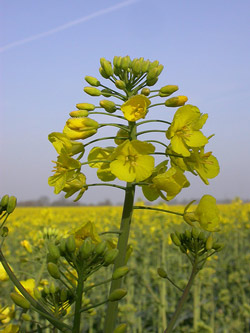
Photograph courtesy of Nick Saltmarsh
Other factors that cause these statistics to vary are the climate and soil that the canola plants are grown in. Humidity and temperature, combined with fertilizers, affect the nitrous oxide emissions.
The Good:
• The seeds have a 43% oil content - more than twice that of soybean.
• North Dakota State University (NDSU) has come out with a breed of canola that has a 15% oil increase over the commercial strain.
• Its cloud point is really low… 37°F (3°C)!! Which is the lowest of all the major oil plant crops.
• Imperiam Renewables created a B99 blend that is good down to 9°F!
The Bad:
• Canola is not being welcomed in some areas of the country because it cross-pollinates with brassica crops and is able to carry and transmit many of the same diseases.
• The U.N.’s Intergovernmental Panel on Climate Change estimates that 1% of fertilizer used for Canola crops turns to Nitrous Oxide.
And the Ugly…
• This biodiesel crop can require lots of Nitrogen fertilizer. The fertilizer reacts with microbes in the soil that cause nitrous dioxide to form from the fertilizer. Nitrous oxide (a major greenhouse gas) has 298 times more of an impact than carbon dioxide, when compared by unit of weight.
Return from 'Canola Biodiesel' to 'Biodiesel Crops'
Biodiesel Homepage
