What Biodiesel Chemicals,
Specifically Catalysts, are Used?
Search this site!
Lye and potash are the biodiesel chemicals most popular with home-brewers to perform trans- esterification.
Large production facilities tend to use heterogeneous catalysts because they can use them over and over again before they expire.
Below are lists of calalysts popular with each group.
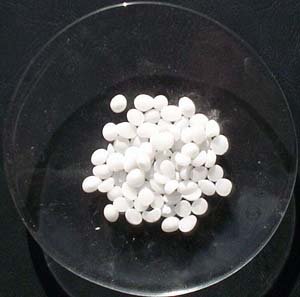 Catalysts Popular With Home-brewers:
Home-brewers working with waste vegetable oil generally use either lye or potash to perform trans- esterification. Lye and potash are not able to be re-used after the process is complete.
Heterogeneous catalysts can be reused- but only a couple of times when using WVO which doesn't make them very cost effective for most home-brewers. I didn't include them in this section.
• Lye (NaOH or caustic soda) – It is cheaper than potash, and is easier to find. It should be at least 96% pure, and needs to be the same purity for the titration and the reaction. Lye can be obtained locally from soap making supply stores. Hydrogen gas can form when lye comes in contact with aluminum, tin, brass, bronze, chromium and zinc. Many home brewers store lye in heavy plastic bags.
• Potash (KOH or potassium hydroxide) – Do not use anything less than 85% pure. Be sure to use the same purity of potash for the titration and reaction. It is more popular than lye because it is easier to dissolve.
I purchase my Potassium Hydroxide from Duda's. Expect to pay quite a bit extra to ship a chemical!
Catalysts Used By Large Production Facilities:
• Heterogeneous catalysts are popular with commercial biodiesel production facilities. These catalysts are in a different form from the reactant. They will not dissolve in methanol or biodiesel. This type of catalyst is easy to separate from the reaction product.
• Sodium methylate (CH3ONa, alcoholate, methoxide, sodium methoxide) - This is usually used as a mix that is 30% sodium methylate, the rest methanol. When trans- esterification is complete the methyl esters and glycerin are separated, and the glycerin is of high quality. It is very hard to get because is highly regulated.
• Potassium Methylate – This biodiesel chemical can be used when making biodiesel from waste vegetable oil. This is sold in a water-free methanol solution of 32% potassium methylate.
Catalyst News:
• The company Benefuel uses a solid acid catalyst that can turn oil biodiesel without processing beforehand. No soap is formed in the process, and the glycerin is of high quality.
In Summary:
There seems to be one main difference in biodiesel chemicals when used for large scale or small scale production, and it all stems from whether the oil is new or used. Home-brewers using WVO, use a catalyst that dissolves in the methanol, and large scale production facilities tend to use reuseable heterogeneous catalysts.
Return from 'Biodiesel Chemicals Esterification' to 'Making Biodiesel Fuel''
Biodiesel Homepage
